AI, Vibe Coding, and the Vanishing Junior: A Frank Look at the Career Ladder
Every few years, technology shifts the ground under our feet. Generative AI is one of those shifts—and it’s hitting the first rung of the career ladder the hardest. Entry roles across functions are getting automated or radically accelerated. That’s great for efficiency. It’s not so great for how people actually become experts.
This post takes a clear-eyed look at both sides:
- Why junior jobs are getting squeezed (especially in tech with vibe coding), and
- Why removing juniors creates a talent time-bomb for everyone—startups, enterprises, and entire economies.
We’ll keep the lens global, with practical notes for Serbia and similar markets.
What changed: vibe coding and AI-first workflows
In software, the new pattern is simple: tell an AI what you want, accept the scaffolding it generates, and keep prompting until it “feels” right. That’s vibe coding. The upside: you jump from idea to running app absurdly fast. The downside: if you don’t fully understand what was built, troubleshooting becomes guesswork, not engineering.
Zoom out and this repeats in other functions:
- Marketing drafts first-pass copy with AI.
- Support triages and answers common questions with AI.
- Ops, finance, and legal automate the repetitive, rules-based work.
All of this used to be junior territory—the proving ground where you learn the craft by doing the “boring bits” and watching how seniors correct your mistakes. AI now does those bits, instantly.
Are entry roles disappearing?
In many teams the answer is: fewer of them, yes.
Not because leaders hate juniors, but because the stack now ships with a built-in assistant. The first passes—summaries, boilerplate code, templated responses—appear with a prompt. Managers re-scope teams toward review, integration, and exceptions. If you’re hiring for that shape of work, you optimize for people who can review, integrate, and handle exceptions—i.e., mid-level and senior talent.
This is visible in tech, customer service, back-office ops, and content-heavy roles. It’s also visible in Serbia and nearby markets: when budgets get tight, companies prefer “plug-and-play” mid/senior talent, and junior openings dry up. Add AI to the mix, and the threshold for a new hire climbs even higher.
The uncomfortable question: if we skip juniors, where do seniors come from?
There’s a hidden dependency in every high-performing team: someone taught your seniors how to be seniors. They learned by handling the basic tasks, getting it wrong, getting corrected, and gradually taking on more ambiguity.
When AI absorbs the early repetitions, two things happen:
- Newcomers struggle to build muscle memory.
- Organizations lose their farm system—the place where future leads, architects, and managers quietly grow up.
If you celebrate short-term speed and ignore this pipeline, you inherit a future problem: not enough humans who understand the system when the system gets weird.
“But won’t AI replace seniors too?”
Some day, many senior tasks will be more automated than they are now (advanced Vibe Coding :-)). Strategy, architecture, even creative direction will be heavily AI-augmented. That doesn’t mean “no humans.” It means the human role changes: less keystrokes, more judgment; fewer handoffs, more decisions; less manual triage, more owning outcomes.
Right now, the pattern inside mature teams looks like this:
- AI drafts; humans decide.
- AI proposes; humans reconcile trade-offs.
- AI guesses; humans carry the risk.
Even in code, seniors increasingly act as AI editors—setting guardrails, validating outputs, and fixing the subtle failures. That editorial layer is harder than writing boilerplate from scratch. It demands depth, not just tools.
A pragmatic playbook: keep the first rung, redesign the steps
Leaders don’t have to choose between efficiency and a talent pipeline. You can have both—if you intentionally redesign work.
1) Apprenticeship 2.0 (AI-native)
Give juniors real responsibility, but pair it with AI and structured review:
- “AI first pass → junior improves → senior signs off.”
- Measure juniors on quality of edits, not volume of drafts.
- Make “how to prompt, verify, and escalate” part of onboarding.
2) Carve the ladder into smaller steps
Don’t jump from “no experience” to “own this critical service.” Create modular roles:
- AI research/triage → human summarization → senior synthesis.
- Test-writing & validation → small feature ownership → subsystem ownership.
3) Codify judgment
Document the why behind decisions. Juniors can’t learn judgment if it stays in seniors’ heads. Turn tribal knowledge into checklists, examples, and short write-ups linked to the code, ticket, or campaign.
4) Make verification a first-class skill
Treat “AI output verification” like unit testing:
- Define acceptance criteria for responses, code, and analyses.
- Require a simple “prove it” step (source links, test cases, reproducible queries).
5) Reward teaching
Tie part of senior performance to mentoring outcomes: how fast juniors ramp, how often AI mistakes are caught upstream, how well the playbooks improve.
6) Hire for attitude + meta-skills
Across functions, juniors who thrive share traits: curiosity, communication, willingness to show their work, comfort with tools and with saying “I don’t know (yet).”
A note for Serbia and similar markets
Local ecosystems feel every global shock harder: fewer large anchor companies, thinner internship traditions, and less slack for “learning in public.” That makes deliberate pipelines even more important. Practical steps that work here:
- Cohort internships with a clear curriculum and real deliverables.
- Partner projects with universities and bootcamps focused on AI-assisted workflows (not just theory).
- Small-company guilds: a few firms pooling mentoring time, code reviews, and brown-bags so juniors see different environments without job-hopping.
Where Positive d.o.o. stands
We use AI daily—and we invest in people. Our approach:
- AI as accelerator, not replacement. We design workflows where juniors contribute meaningfully with AI, and seniors focus on judgment and system-level quality.
- Tight guardrails. We build verification and audit into the process so learning is safe and errors are caught early.
- Document the “why.” We turn senior decisions into artifacts juniors can study and reuse.
- Grow specialists. We rotate newcomers through focused, AI-augmented roles (retrieval, evaluation, testing, prompt design) before expanding scope.
The result is faster delivery today and a stronger bench tomorrow.
The provocation (and the promise)
If you remove junior roles, you may enjoy a year of dazzling velocity and then spend the next five untangling the consequences. If you keep junior roles exactly as they were, you’ll move too slowly and lose to teams that embraced AI.
The middle path is the hard one—and the right one:
Redesign work so people learn faster with AI than they ever did without it.
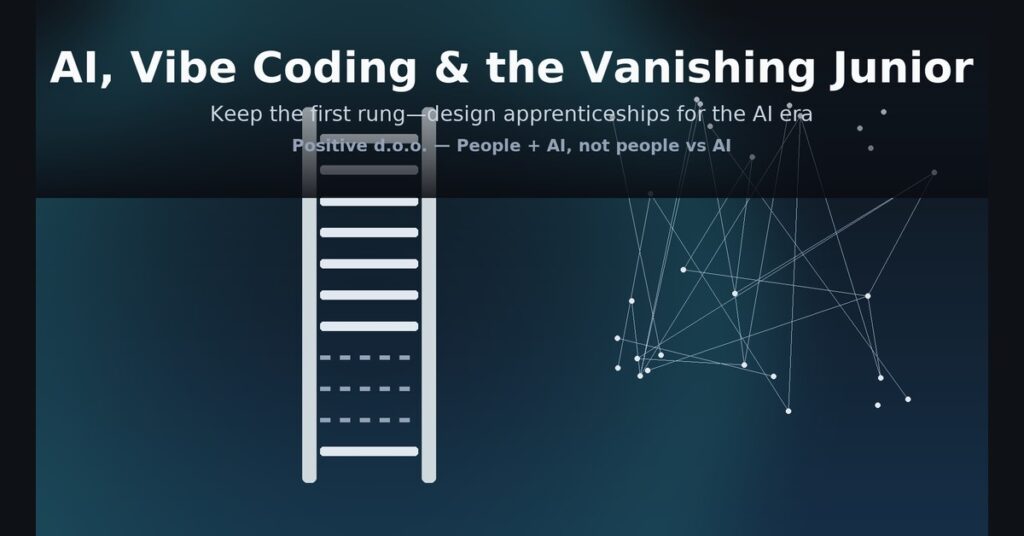
Keep the first rung. Make it smarter and safer. Make it count.
Share