From DMs to Delivery: Deploying Messaging-Native AI Agents for SMB Growth (WhatsApp & IG)
For many small and mid-size businesses, the real action no longer starts on the homepage—it starts in the inbox. Customers ask questions, request quotes, and place orders in WhatsApp and Instagram DMs. That’s why we’re seeing a shift from “add a chatbot to the website” to “make messaging the storefront.” Below is a practical playbook—grounded in today’s platform capabilities—for launching an AI agent that handles FAQs, captures order details, and hands clean data to your back office.
At Positive d.o.o. (Novi Sad), we build these agents with a clear goal: faster response, fewer manual steps, and reliable, compliant data flows.
Why chat is the new storefront
- Official rails exist. Meta provides the WhatsApp Business Platform (Cloud API or on-prem) and recently moved to per-message pricing (effective July 1, 2025), which changes how you model costs and ROI. Meta for DevelopersWhatsApp Business
- Instagram DMs are fully supported for Professional accounts via the Instagram Messaging/Graph API—send/receive messages, subscribe to webhooks, and integrate with your CRM. Meta for Developers
- Meta Business AI is now an opt-in layer businesses can use on WhatsApp to automate parts of a conversation (disclosures + consent apply). You can pair it with your own RAG/LLM logic for brand-accurate answers. WhatsApp Help Center
Minimum Viable Messaging Agent (MVA)
Start small. Ship something that’s useful on day 1 and extensible on day 30.
- Scope the intents
- FAQs: hours, delivery zones, returns, payment methods
- Product Q&A: sizes, colors, stock, bundles
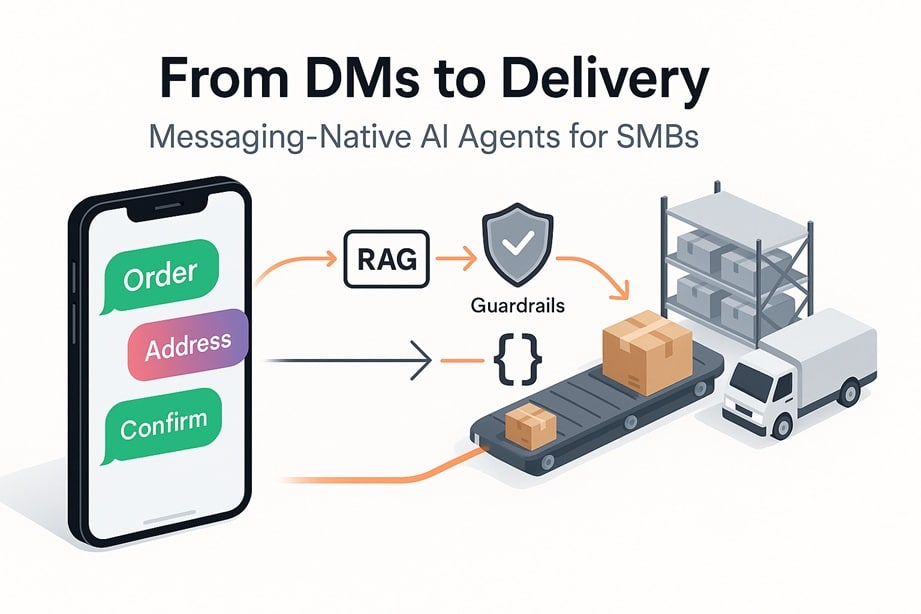
- Order capture: name, phone, item/SKU, quantity, address
- Ground answers (RAG)
Use retrieval-augmented generation so the agent answers from your catalog/policies, not the open web. Azure’s RAG guides are a solid design reference for enterprise setups. Microsoft Learn Microsoft Azure - Human-in-the-loop
Add a simple “Escalate to human” button and confidence thresholds. The agent should recognize when to defer. - Privacy & consent
Make AI use clear and optional in WhatsApp (per Meta’s guidance). Don’t store PII you don’t need. WhatsApp Help Center
Guardrails you actually need
- Positive Guardrails (our in-house framework). We enforce policy and safety with a developer-first rules engine that runs inline with every message. Core capabilities:
- Policy DSL: allow/deny rules for topics, intents, and tools (e.g., “orders only via validated SKU list,” “no payment links in free-form replies”).
- Retrieval-only mode: for policy/product answers the agent must cite your corpus; free-compose is blocked unless confidence ≥ threshold.
- PII & compliance filters: detection + masking of phone, email, address; optional hashing/redaction in logs.
- Prompt-injection & jailbreak resistance: pattern/semantic checks before tool calls; auto-rollback on risky turns.
- Output contracts: JSON/Markdown schema validation; auto-repair or escalate to human if invalid.
- Audit trail: full trace (user prompt, retrieved docs, policy hits, final response) for QA and regulatory review.
- Human-in-the-loop by design. Confidence/coverage scoring triggers a one-tap escalation to a live agent.
- Config as code. Environments (pilot → prod) get versioned guardrail bundles; changes are reviewed and rolled out like any other code.
Back-office plumbing (the “delivery” part)
Your agent isn’t done until operations can ship.
- Order object. Normalize DM text into a structured order:
{customer, items[{sku, qty}], address, notes}. - Validation. Check SKUs & stock, validate addresses, confirm totals—then request one-tap confirmation.
- Systems of record. Push to your OMS/WMS/ERP (or a lightweight Google Sheet to start).
- Status messages. Use WhatsApp templates for confirmations/updates when appropriate—and log everything.
Metrics that matter (beyond website clicks)
- Resolution rate (answers solved without human), time to first reply, time to resolution
- Conversion from DM (quote → paid order), average order value from DM flows
- AI visibility: are your catalog/policy pages being cited by AI search (RAO)? If yes, DMs often follow. (Google’s AI Overviews illustrate how answers now synthesize from sites; structure your content accordingly.) blog.google
Costs & the new WhatsApp pricing reality
- WhatsApp: as of July 1, 2025, Meta moved from conversation-based to per-message pricing with updated rates/tiers—plan for message volume, not just sessions. Meta for DevelopersWhatsApp Business
- LLM: start with a managed API; shift to smaller fine-tuned models for high-volume intents to cut latency and unit cost (run on your infra if data sensitivity demands).
- Ops: budget for guardrails, monitoring, and occasional human review—this keeps accuracy and trust high.
30-Day rollout plan (what we do at Positive)
First Week — Foundation
- Pick 5–10 intents; draft answer snippets from your policies/catalog.
- Stand up WhatsApp Business API (Cloud) and Instagram Messaging webhooks. Meta for Developers
- Implement RAG over a small, curated corpus (FAQs, top products, shipping/returns). Microsoft Learn
Week 2 — Guardrails & flows
- Enable Positive Guardrails: turn on retrieval-only answering for policy/product queries, PII masking, output schema checks, and escalation rules.
- Build the order-capture flow with SKU/stock validation and address checks + human handoff.
- Set up logging dashboards (resolution rate, policy hits, escalations) and redaction in storage.
Week 3 — Pilot
- Roll out to a small customer segment; measure resolution rate and DM→order conversion.
- Review escalations to improve instructions and retrieval set.
Final Week — Scale & refine
- Expand intents (returns/exchanges, promos).
- Tune a small model for the highest-volume intent to reduce cost/latency; keep the general model as fallback.
- Prepare a short EU AI Act note: purpose, data sources, guardrails, contacts. (SMEs will have prioritized access to regulatory sandboxes—useful for testing novel flows.) Artificial Intelligence Act+1Digital Strategy
Common pitfalls to avoid
- Unbounded answers. Use retrieval-only rules so policy/product replies must cite your corpus; block free-compose when confidence is low.
- Schema drift. Enforce output contracts so the bot returns valid JSON for your back office every time.
- No safety net. Configure escalation thresholds—don’t let the bot “guess” on orders, payments, or exceptions.
- Leaky logs. Turn on PII masking + retention limits in guardrails so DM data isn’t over-collected.
The Positive d.o.o. approach
We design for messaging-first with our own Positive Guardrails framework at the core: retrieval-grounded answers, policy-aware tool use, validated outputs, and built-in escalation. We start with one measurable outcome (e.g., DM → paid order), then expand intents and channels. As volume grows, we introduce small, fine-tuned models for the highest-traffic intents to cut latency and unit cost, while keeping a general model as fallback—all governed by the same guardrails and audit trail.
Result: faster answers, fewer manual handoffs, and clean order data—from DMs to delivery.
If you’d like to learn more about my AI journey, you can read this next.
Share