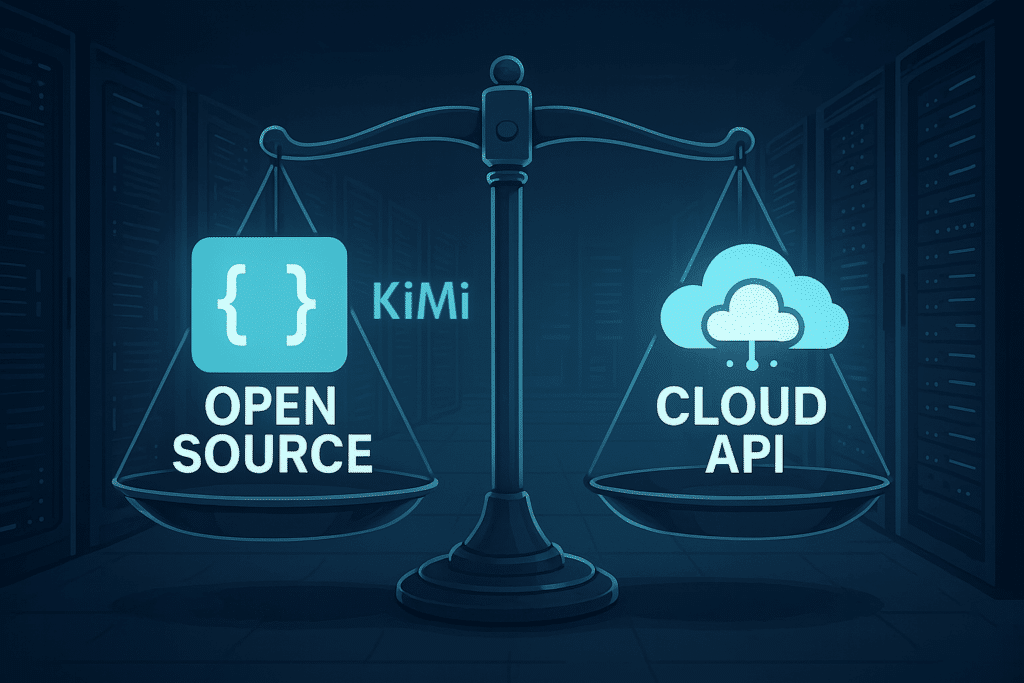
Open vs Proprietary LLMs: Choosing the Right Path for Your Business
Understanding the LLM Landscape: Open vs Proprietary LLMs
Large Language Models (LLMs) have become pivotal in business transformation, powering everything from customer service chatbots to advanced data analysis. At a high level, open-source LLMs are models whose code and often weights are publicly released for anyone to use, modify, and deploy, typically under permissive licenses. In contrast, proprietary LLMs are closed models owned by companies and offered as a paid service (usually via an API) without access to the underlying model internals. This fundamental difference drives a host of implications in terms of cost, control, performance, and strategy.
An Example
Example – The Rise of Kimi K2: One of the latest and most talked-about open models is Kimi K2, released in mid-2025 by Moonshot AI (a Chinese AI lab). Kimi K2 is a 1 trillion parameter mixture-of-experts model designed for “agentic” capabilities – meaning it can not only answer questions but also use tools and make decisions autonomously. Crucially, Moonshot AI made Kimi K2’s weights and code publicly available under a modified MIT open-source license. What’s “open” about Kimi K2? Essentially everything: researchers and developers can freely download the model from GitHub/Hugging Face and run it on their own hardware. There’s no paywall, no special permission needed – a stark contrast to many “open” AI models that actually hide behind restricted APIs or approval forms.
What isn’t open? Moonshot did impose a minimal condition in the license: if you integrate Kimi K2 into a commercial product that exceeds 100 million monthly users or $20M in monthly revenue, you must prominently credit “Kimi K2” in your UI. In practice, this is a very light requirement (no royalties or usage fees – just an attribution for very high-scale uses), especially compared to typical proprietary models that would charge significantly for that scale of usage. Kimi K2’s openness means businesses of any size can experiment with a state-of-the-art model in-house. In fact, Kimi K2’s performance on coding and STEM benchmarks is on par with or even superior to leading proprietary systems like OpenAI’s GPT-4 and Anthropic’s Claude on many tasks. This is a testament to how far open models have come – and it underscores why the open vs proprietary question is so important today.
Why the Choice Matters for Business
If both open-source and proprietary models can perform similar types of tasks, does it really matter which you choose? Yes – and it boils down to key business factors: innovation, cost, data control, and risk. The “open-door vs closed-door” approach influences how you can leverage the technology and how it aligns with your strategic needs. Below, we break down the major considerations:
Innovation & Customization
- Open-Source Advantage: Open LLMs allow far greater customization. Your team (or partner developers) can fine-tune the model on your proprietary data, optimize its behavior, or even extend its capabilities by modifying the code. Because the model weights are accessible, you have “full control” to adapt the AI to your domain-specific needs. This flexibility also means faster innovation cycles – you’re not waiting on an external vendor’s update schedule to implement new features. In an open ecosystem, a global community of researchers is constantly improving models and sharing enhancements, which you can directly leverage. For instance, if you wanted Kimi K2 to have a better handle on legal documents or Serbian language, you could fine-tune it with your own examples and immediately deploy the improved model internally. Such agility can be a competitive edge for businesses willing to invest in tailoring their AI.
- Proprietary Advantage: Proprietary LLMs, while less flexible, often come highly polished and optimized out-of-the-box. They are built and maintained by AI giants with immense R&D resources, so they may offer cutting-edge performance or specialized capabilities that open models haven’t replicated yet. As of early 2024, for example, GPT-4 was generally the quality leader in many NLP tasks. For businesses without a strong technical team, using a closed model can be beneficial – you get a sophisticated solution without needing to tweak or maintain the model yourself. However, the trade-off is less customization. You are essentially confined to the feature set and improvement timeline the provider gives you. Relying on a vendor for every update can slow down innovation; you might request a new feature or fix and have to wait, whereas an open model you might implement or prompt-engineer a workaround in-house. In fast-moving domains, that dependency is a consideration.
Accessibility
- Open-Source Advantage: Open models can offer dramatic cost savings, especially at scale. There are no licensing fees to use the model itself – once you’ve downloaded an open LLM, you can run unlimited queries for free, aside from infrastructure costs. This makes a huge difference when usage volume is high. For example, one comparison found that running an open model roughly equivalent to a 70B-parameter Llama cost about $0.60 per million input tokens and $0.70 per million output tokens (essentially the GPU compute cost), whereas a proprietary model like GPT-4 via API cost about $10 per million input and $30 per million output – on the order of 10× more expensive for the closed model.
- Over millions or billions of tokens, that cost gap is staggering. Moreover, if you already have capable hardware (or cloud credits), hosting an open LLM can be cheaper than paying API fees for heavy usage. Many companies are attracted to open LLMs for this potential ROI, especially for applications that need to process large volumes of data.
Cost
Costs to Consider: It’s important to note that “free to use” doesn’t mean “free to run.” Open LLMs require GPU servers or cloud instances to operate, and those can be expensive (often 5–16× the cost of a standard CPU server per hour). You’ll also incur costs for engineering time to deploy and optimize the model. In other words, open-source shifts the expense from license fees to infrastructure and personnel. If your company doesn’t have the in-house expertise, you might spend on outside experts or platforms to manage the model. As a business leader, you should model both the short-term and long-term costs: for low or unpredictable usage, a pay-as-you-go proprietary API might be more economical, but for high steady usage, investing in an open model could save money overall.
- Proprietary Model Costs: Proprietary LLM providers typically charge per usage (per token input/output). These costs can add up quickly, but in return you get a fully managed service. You don’t have to purchase hardware or hire specialists to maintain the model – the provider handles scaling, uptime, and model improvements behind the scenes. For many businesses, this OpEx vs CapEx trade-off is key. Startups, for example, might start with an API (low upfront cost, higher variable cost) to validate an idea, then switch to an open model as they scale up and usage grows. It’s also worth considering support and opportunity cost: with a closed model, your engineers can focus on product features rather than model internals, which might be valuable if AI is not your core domain.
Data Privacy & Security
- Data Control with Open-Source: In an era of heightened data privacy concerns, open-source LLMs give you full control over your data. When you self-host an LLM (whether on your own servers or a private cloud), sensitive information stays within your managed environment. You’re not sending customer data or proprietary documents off to a third-party API for processing. This is crucial for industries like finance, healthcare, or government, where regulations or company policies might prohibit sharing data with external services. Moreover, with open models you can audit the code and even the training data (to an extent) to ensure there are no hidden data logging or usage issues. The transparency of open-source software means potential vulnerabilities or privacy gaps can be spotted and addressed by the community, giving some extra assurance. Many companies choose open LLMs specifically to build solutions behind their own firewall, ensuring compliance with data protection standards.
Third-Party Risk
- Third-Party Risk in Proprietary Models: Using a closed LLM service inherently means sending data outside your organization. Even if the vendor has strong security, this introduces risk. In fact, sharing any internal data with a third-party (AI or otherwise) must be weighed carefully. Leading LLM providers have improved their terms – for example, many now promise not to use your API data to retrain models, and they offer enterprise plans with data isolation. However, high-profile incidents have shown it’s not risk-free (e.g., an early ChatGPT bug allowed some users to see others’ conversation histories, raising confidentiality concerns).
- Additionally, when your data is processed by a vendor’s servers, there’s always a chance of leaks or breaches outside of your control. From a legal standpoint, ownership of outputs and liability for training data are gray areas too. Proprietary providers might not offer full indemnity if their model inadvertently violates copyrights or privacy with its outputs. In contrast, if you run an open model yourself, you have greater control over how data is handled and logged, reducing the surface area of third-party exposure. To put it simply: if data security is paramount, leaning toward open-source (or a self-hosted proprietary model) is often advisable.
Performance & Support
- Performance: Not long ago, proprietary LLMs unquestionably outperformed open ones – after all, companies like OpenAI, Google, and Anthropic could train gargantuan models with billions of dollars in compute. But the gap has been rapidly narrowing. By mid-2025, open models like Kimi K2 and Meta’s Llama 2 are matching or surpassing proprietary models on many benchmarks. The open-source community’s “hive mind” has led to innovations (like techniques to fine-tune smaller models to reach GPT-3.5 level performance, or the Mixture-of-Experts approach in Kimi K2) that closed players now compete with.
- This is a pivotal point: if an open model can achieve roughly the same quality as a closed model for your use case, the balance tips towards open on factors like cost and control. In fact, surveys indicate that 82% of enterprises are open to switching from closed to open models if the open ones reach parity in performance. The top reasons cited are the desire for more control, customizability, and cost savings. That said, not every open model is better – the absolute cutting-edge model in some niche might still be proprietary. Businesses should evaluate their specific task: is the slight quality edge of a closed model critical, or can an open model suffice with proper fine-tuning?
Support
- Support: With a proprietary service, you usually get professional support and a degree of reliability guarantees. Vendors may offer 24/7 support lines, SLAs (service-level agreements) for uptime, and compliance certifications (e.g., SOC 2, HIPAA compliance) which are important for enterprise adoption. If something goes wrong with the model or if you need an enhancement, you can turn to the provider’s support team. Open-source, conversely, relies on community support unless you have a vendor or internal team to take on that role. For a company without AI expertise, the lack of official support could be a risk – but this is where third-party integrators (like AI solution providers) come in to fill the gap by offering services around open models. It’s also worth noting that open-source communities are often very active; you can find help on forums or GitHub, but it’s on a best-effort basis.
- In summary, closed LLMs offer a “one throat to choke” – a vendor accountable for the performance and security of the model – whereas open LLMs put that onus on your organization (or your implementation partner). Some businesses will value the assured support of a proprietary model, while others with strong engineering teams might prefer the autonomy of open solutions.
Strategic Considerations: Finding the Right Fit
For most organizations, the decision is not strictly either-or. In practice, many adopt a hybrid approach – using open-source LLMs in some areas while leveraging proprietary APIs in others, depending on what makes sense for each use case. Here are a few strategic tips for decision-makers:
- Assess Your Use Case and Scale: If you are experimenting with a new AI feature and speed is of the essence, a proprietary API (like OpenAI, Microsoft Azure OpenAI, Google PaLM/Bard) can get you started in minutes. The upfront integration is easier (just an API call) and you avoid heavy setup costs. However, if this feature is core to your business and will scale to millions of requests, start planning for an open-source or self-hosted solution to manage long-term costs. Many companies prototype with a closed model, then migrate to an open model (or bring the model on-premises) once the product matures. The key is to architect your system with flexibility in mind – e.g., by using an abstraction layer so you can swap out the underlying model later without a complete rewrite.
Talent and Expertise
- Consider Talent and Expertise: Do you have (or plan to hire) AI/ML engineers who can handle model operations? Open LLMs require MLOps work – model provisioning, optimization, monitoring, etc. If your team is up to it, the investment can pay off in independence. If not, you might lean towards a managed solution or engage a partner. Third-party solution providers like Positive can be invaluable here – for example, at Positive d.o.o. (Novi Sad, Serbia), our team specializes in developing and integrating LLM-powered solutions for businesses. We’ve seen companies succeed with open models by leveraging our expertise in fine-tuning and deployment, even when they didn’t have an internal AI team. On the flip side, we also help clients integrate proprietary models when appropriate, ensuring they get enterprise-grade support and reliability. The decision often comes down to what resources you have and whether you want to build those capabilities in-house.
Risk
- Evaluate Compliance and Risk Tolerance: If your industry has strict compliance requirements (banking, healthcare, public sector, etc.), the ability to self-host and audit an open model can be a game-changer. Open-source allows you to enforce whatever security controls you need at the infrastructure level. You can also ensure no data is leaving your control. However, some proprietary vendors now offer on-prem or dedicated instances for enterprise (albeit at high cost) to address this. Weigh the risks: are you comfortable trusting a third-party with sensitive data after due diligence and contracts? Or is it a strategic advantage for you to say “all AI processing stays in-house”? Your customers and regulators might prefer the latter, and that could influence your choice.
- Long-Term Strategy – Avoid Lock-In: Technology landscapes shift quickly. Today’s leading model might not be the leader next year. As a business strategy, try to avoid lock-in to any single AI provider or model. Open-source ethos is helpful here: by adopting open standards and models, you keep the freedom to switch or modify as needed. Even if you go proprietary, insist on clear contractual terms regarding data ownership and the ability to extract your data/models if needed. The good news is that many LLMs use similar interfaces (for instance, OpenAI’s API has become a quasi-standard, and open models often provide compatibility layers). The more your solution is architected to be model-agnostic, the more leverage you have to choose or change your LLM approach as the field evolves.
The Bottom Line: Why It’s Important
Choosing between open-source and proprietary LLMs isn’t just an IT decision – it’s a strategic business decision. It impacts your innovation velocity, cost structure, data governance, and even your competitive differentiation. Open-source LLMs embody the democratization of AI, offering incredible capabilities to organizations of all sizes without the gatekeeping of Big Tech. They foster a spirit of collaboration and transparency; as one IBM AI expert put it, the openness brings benefits of community-driven improvements, easier fine-tuning, and greater transparency into how the AI works. This can translate into faster feature development, lower costs, and more trustworthy AI for your business. Meanwhile, proprietary LLMs offer convenience, top-tier performance, and turnkey solutions, which can be crucial for getting projects off the ground quickly and confidently.
Businees point of view
From a business point of view, it’s important to weigh the pros and cons through the lens of your goals. Are you trying to minimize time-to-market, or optimize total cost of ownership? Do you need full control for compliance, or would you rather offload complexity to a vendor? There’s no one-size-fits-all answer. Many enterprises will find a balanced approach works best – using closed models where they provide unique value, and open models where you need control and customization. The very presence of high-caliber open models like Kimi K2 is shifting the calculus: when open-source options rival the proprietary giants, businesses suddenly have more negotiating power and technological autonomy. In fact, industry surveys show a clear trend of companies embracing open-source LLMs to gain greater control, customizability, and cost-effectiveness.
At Positive, we’ve witnessed this transformation first-hand while helping clients in their digital transformation journeys. The excitement is palpable – imagine having GPT-4-level capabilities on your own servers, tuned to your data, without a per-query fee. This is increasingly becoming reality. But we also temper that excitement with pragmatism: running your own AI comes with responsibilities and challenges. Our role is to guide businesses through these choices – whether that means deploying an open-source model like Kimi K2 securely for a client, or integrating a proprietary model into their workflows in a cost-efficient manner.
Ultimately, the importance of the open vs proprietary debate is that it empowers you, as a business leader, to make AI strategy a deliberate choice rather than a default. You can choose the path that best aligns with your company’s values, capacities, and objectives. And by making an informed choice, you put your organization in the best position to harness the promise of LLMs for competitive advantage in this new era of AI-driven business.
Read more about my AI journey
Share